

PTAC Service
RESIDENTIAL HEATING & COOLING
PACKAGED TERMINAL AIR CONDITIONER SERVICE
PTAC units provide heating and cooling from a compact system installed directly through the exterior wall. Common in New York apartments, condos, and high-rise buildings, these units combine several HVAC components in one cabinet and require proper diagnostics when cooling, heating, airflow, or controls stop working as expected.
HVAC.Services provides professional PTAC repair, maintenance, replacement, and installation for residential systems, including units installed in existing wall sleeves where dimensions, voltage, and cooling capacity must be matched correctly.
COMPLETE SYSTEM CARE FOR RESIDENTIAL COMFORT
REPAIR
We diagnose PTAC problems, identify the failed component, explain the repair options, and complete the necessary work to restore normal heating, cooling, airflow, and system operation.
MAINTENANCE
We inspect the PTAC, check operating condition, airflow, filters, coils, drainage, and controls, and perform routine service to keep the unit working properly through the season.
INSTALLATION
We install PTAC units in compatible wall sleeves, verify electrical requirements and fit, secure the equipment properly, and test the system after installation for correct operation.
REPLACEMENT
We evaluate the existing PTAC, confirm sleeve dimensions, voltage, and required capacity, help select a compatible replacement unit, and handle removal and installation of the new system.
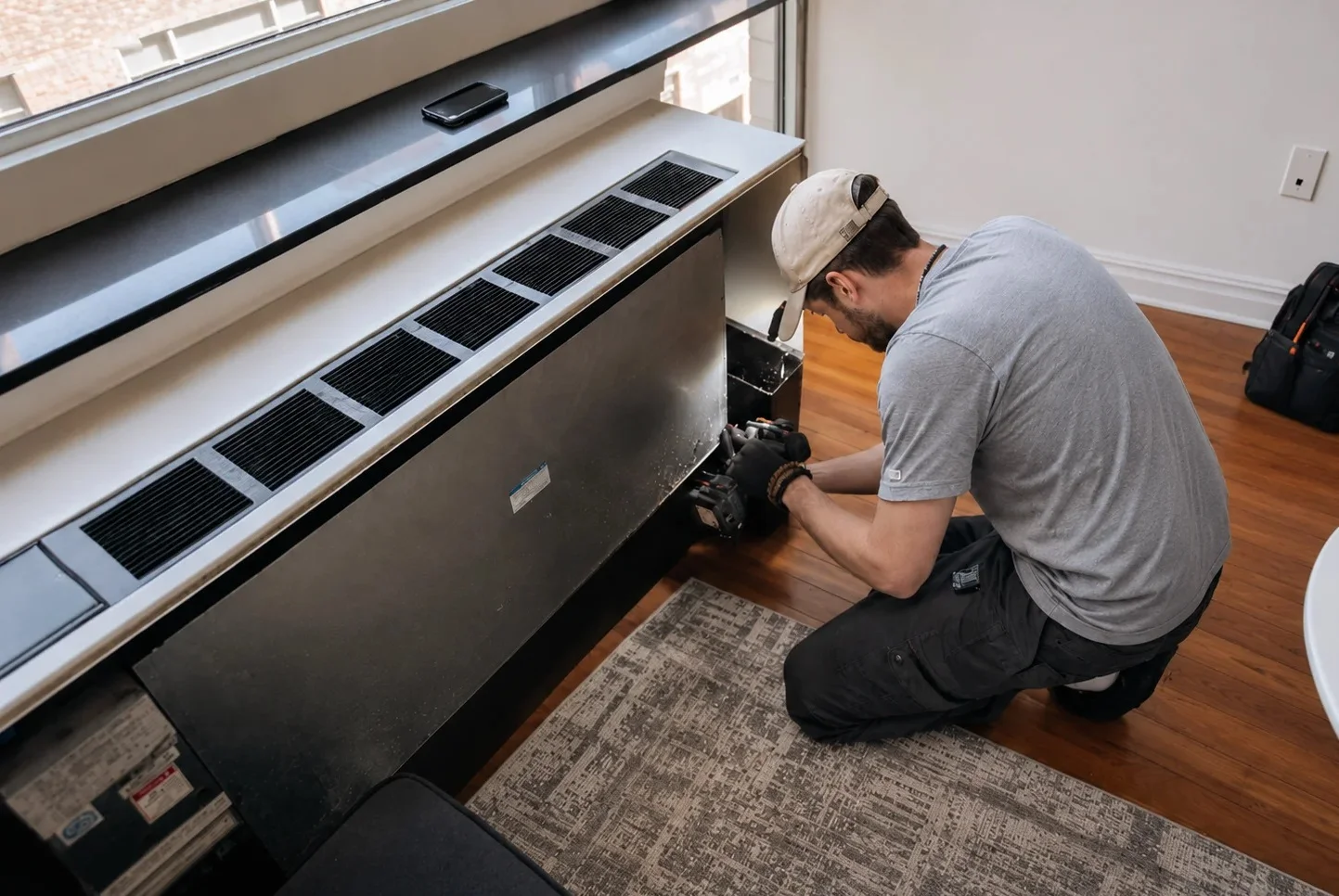
WHY PTAC SERVICE REQUIRES THE RIGHT EXPERTISE
A PTAC may still run even when cooling capacity, airflow, heating performance, or temperature control has started to decline. Dirty coils and filters, drainage problems, worn fan components, electrical faults, thermostat issues, and refrigeration problems can produce similar symptoms, so the source of the problem is not always obvious from the way the unit behaves.
HVAC.Services technicians test the unit as a complete heating and cooling system, checking the components and operating conditions related to the reported problem. Professional diagnostics help determine whether the PTAC needs routine service, a specific repair, deeper cleaning, or replacement — and avoid replacing a unit that can still be repaired economically.
PTAC SYSTEM CHECK
FINDING THE SOURCE OF SYSTEM ISSUES
COOLING AND HEATING PROBLEMS
Weak cooling, insufficient heat, uneven temperatures, short cycling, or a unit that runs without reaching the set temperature can point to several different PTAC faults. Diagnostic testing helps determine whether the problem is related to airflow, controls, heating components, or the refrigeration system.
NOISE, AIRFLOW AND DRAINAGE ISSUES
Reduced airflow, unusual vibration, water leakage, musty odors, or changes in operating noise often indicate conditions that need to be traced before parts are replaced. We check how the PTAC moves air, drains condensate, and performs during normal operation.
STARTUP AND CONTROL FAILURES
A PTAC that will not start, shuts down unexpectedly, ignores thermostat settings, or switches modes incorrectly may have an electrical, sensor, control, or sequencing problem. Diagnostic testing helps isolate the source of the fault before repair begins.
PTAC COMPONENTS WE SERVICE
COMPRESSOR
& REFRIGERATION
Compressor, refrigerant circuit, operating pressures, refrigerant charge, and the components responsible for moving heat between the indoor and outdoor coils.
EVAPORATOR
& CONDENSER COILS
Indoor evaporator and outdoor condenser coils, coil surfaces, heat transfer, frost conditions, dirt buildup, corrosion, and restrictions that affect cooling or heating capacity.
BLOWER
& FAN SYSTEM
Indoor blower, outdoor fan, fan motors, blower wheel, airflow delivery, fan speed, vibration, and the mechanical components that move air through the PTAC.
CONTROLS
& SENSORS
Thermostat controls, temperature sensors, control board, relays, operating modes, fan settings, and electronic components that manage PTAC heating and cooling cycles.
HEAT PUMP
& ELECTRIC HEAT
Electric resistance heat or heat-pump operation, heating elements, reversing components, temperature limits, and controls used to provide heat in PTAC models.
FILTERS
& CONDENSATE
Reusable air filters, drain pan, condensate passages, moisture removal, and airflow paths that help protect the coil and manage water produced during cooling.
FAQ
PTAC heating systems vary by model. Some use electric resistance heat, while others use a heat-pump circuit and may also include auxiliary electric heat. Loss of heating can be related to heating elements, controls, sensors, relays, fan operation, heat-pump components, or the refrigeration circuit. A unit that blows air but produces little or no heat therefore needs more than a thermostat check.
HVAC.Services technicians identify the heating configuration first and test the components that apply to that specific PTAC rather than using the same troubleshooting procedure for every unit.
Yes. PTAC units typically use one or more accessible air filters on the indoor-air side of the system. The filters collect dust and debris before air reaches the evaporator coil and blower. A loaded filter restricts airflow, increases the workload on the fan system, and can contribute to reduced cooling or heating performance and coil icing.
During PTAC maintenance, filter condition should be considered together with airflow and coil condition. HVAC.Services can also determine whether reduced performance is caused by routine airflow restriction or a deeper mechanical or refrigeration problem.
A PTAC removes moisture from indoor air during cooling, so condensate must be managed and drained correctly. Water leakage can be associated with a blocked or dirty drain path, problems with the drain pan, excessive moisture buildup, icing on the evaporator coil, or operating conditions that interfere with normal condensate removal.
HVAC.Services can inspect the condensate system together with airflow and coil condition because a visible water leak may be the result of a drainage problem or another issue developing inside the unit.
Often yes, but compatibility needs to be confirmed before the new unit is purchased. The sleeve dimensions, voltage, electrical requirements, drainage configuration, and required cooling capacity all affect whether a replacement PTAC can use the existing opening. A unit that is physically similar may still be unsuitable for the installation.
HVAC.Services can measure the existing setup, verify installation conditions, help identify suitable replacement options, and install and test the new unit after it arrives.
The decision depends on the condition of the unit, the failed component, repair cost, availability of parts, and the cost of a compatible replacement. Age alone does not automatically make replacement the better choice. PTAC systems can often remain serviceable after replacing major internal components such as a compressor, motor, control board, or coil.
HVAC.Services evaluates the existing PTAC before recommending either option. Where repair is economically reasonable, we can repair the existing system; where replacement makes more sense, we can help identify a compatible unit for the existing installation.
Experience the HVAC.SERVICES Difference


