

VRF / VRV System
MULTI-ZONE HVAC, BUILT FOR COMMERCIAL SPACES
VARIABLE REFRIGERANT FLOW FOR FLEXIBLE CLIMATE CONTROL
VRF and VRV systems connect multiple indoor units to centralized outdoor equipment, allowing different areas of a commercial building to operate with individual temperature control. Refrigerant flow adjusts as demand changes from zone to zone, making the system especially well suited to buildings with varied occupancy and operating schedules.
VRF and VRV installations rely on tight coordination between refrigerant circuits, indoor units, sensors, and controls. A fault in one part of the network can affect several zones and change overall system behavior.
VRF & VRV SYSTEM SERVICES
REPAIR
Diagnostics and repair for refrigerant, control, communication, airflow, sensor, and electrical issues affecting VRF and VRV operation across one or multiple zones.
MAINTENANCE
Routine service for indoor and outdoor units, filters, coils, drains, controls, refrigerant circuits, and communication components throughout the installation.
INSTALLATION
Installation of VRF and VRV equipment for commercial spaces that require flexible zoning, coordinated controls, and efficient use of available building space.
REPLACEMENT
Replacement of aging or failed VRF and VRV equipment, including individual components or larger sections of the installation when upgrades are required.
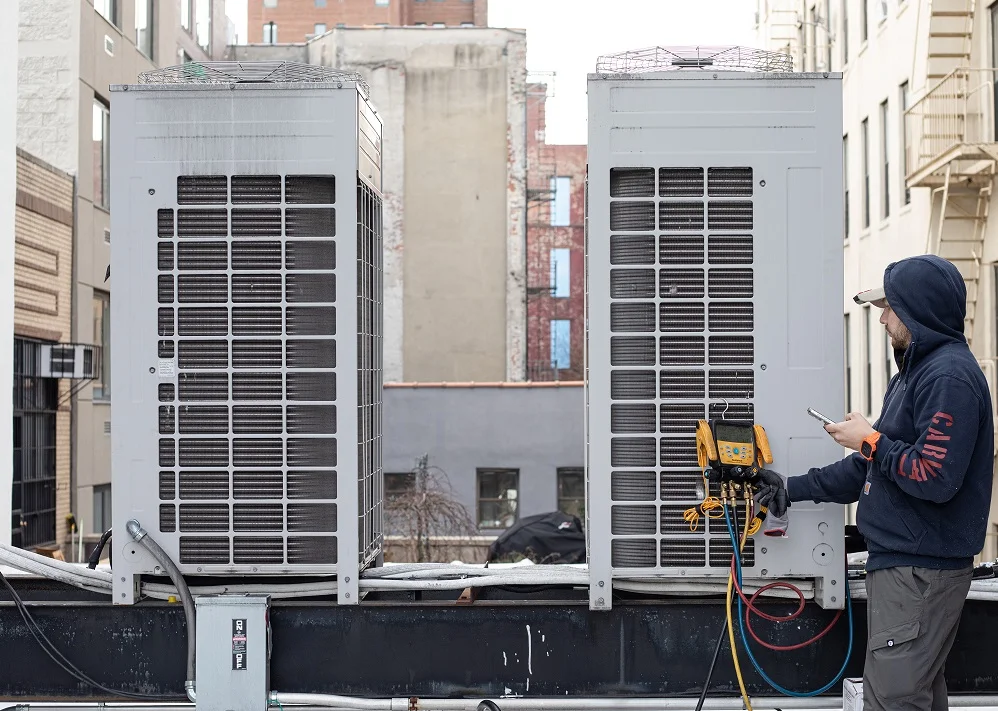
ONE NETWORK. MANY ZONES.
VRF and VRV equipment operates as a connected network rather than a collection of independent units. Outdoor modules, indoor sections, refrigerant piping, sensors, and controls continuously exchange information and adjust operation as demand changes throughout the building.
That makes diagnosis more precise. A cooling problem in one area may originate from local controls, refrigerant distribution, communication faults, or another part of the installation entirely. Proper testing helps separate a zone-specific issue from a problem affecting the wider network.
For commercial properties, accurate VRF and VRV service means understanding how the entire installation behaves under real operating conditions, not just checking the unit where the symptom appears.
FROM ONE ZONE
TO THE FULL SYSTEM
VRF & VRV SYSTEM DIAGNOSTICS
ZONE-SPECIFIC PROBLEMS
Uneven temperatures, weak output, or an indoor unit that behaves differently from the rest can point to local controls, sensors, airflow, refrigerant distribution, or communication issues within that zone.
COMMUNICATION FAULTS
VRF and VRV equipment depends on continuous communication between indoor units, outdoor modules, sensors, and control boards. A fault in that network can affect one area or disrupt operation across multiple zones.
REFRIGERANT BALANCE
Incorrect refrigerant conditions, flow restrictions, piping issues, or component faults can reduce capacity and create uneven operation across the installation. Accurate testing helps identify where the balance is being lost.
VRF & VRV COMPONENTS WE SERVICE
OUTDOOR
MODULES
Outdoor modules manage refrigerant circulation, compressor operation, and changing capacity as demand shifts across the building.
INDOOR
UNITS
Wall-mounted, cassette, ducted, and other indoor units deliver conditioned air to individual zones and respond to local controls.
BRANCH
COMPONENTS
Branch boxes, joints, and distribution components direct refrigerant flow between outdoor equipment and multiple indoor sections.
CONTROLS
& SENSORS
Sensors, controllers, boards, and communication components coordinate zoning, temperature response, and overall VRF or VRV operation.
REFRIGERANT
CIRCUIT
Refrigerant piping, valves, connections, and related components maintain proper flow and support stable operation across multiple zones.
DRAINAGE
& AIRFLOW
Drain pans, condensate lines, filters, fans, and airflow components support moisture removal and consistent operation at the indoor units.
FAQ
A single zone can lose heating or cooling while the rest of the VRF or VRV system continues to operate normally. Possible causes include a problem with the indoor unit, sensor readings, airflow, local controls, refrigerant distribution, valves, or communication with the outdoor equipment. Since the fault may be local or connected to another part of the installation, accurate diagnosis is important before replacing components.
The experienced technicians at HVAC.Services work with complex multi-zone equipment and can trace the problem beyond the room where the symptom appears. Professional testing helps determine whether the issue belongs to one zone or affects the wider VRF/VRV installation.
VRF and VRV error codes can point to sensor faults, communication problems, refrigerant conditions, electrical issues, control-board faults, or problems with individual indoor or outdoor components. The code is useful for narrowing the search, but it does not always identify the failed part by itself. Operating conditions and related components should still be tested before a repair decision is made.
Our experienced commercial HVAC team can interpret system fault information and test the equipment that may be contributing to the error. HVAC.Services focuses on finding the actual cause rather than simply clearing the code and restarting the system.
Maintenance frequency depends on operating hours, building use, the number of indoor units, environmental conditions, and the overall condition of the equipment. Regular service should include indoor and outdoor units, filters, coils, drains, controls, electrical components, and other parts that affect system operation. Commercial installations with long daily schedules or high occupancy may require more frequent attention.
HVAC.Services has extensive experience maintaining multi-zone commercial HVAC equipment. Our technicians can evaluate how the installation is actually being used and recommend a service schedule that fits its workload and condition.
Temperature differences between zones can result from thermostat settings, sensor problems, airflow restrictions, indoor-unit condition, control settings, refrigerant distribution, or changes in occupancy and heat load. Some variation between spaces can be normal, but persistent differences may indicate that one part of the installation is no longer responding as intended.
With years of hands-on experience in commercial HVAC diagnostics, our technicians can compare operating conditions across multiple zones and identify where the imbalance begins. That allows service to focus on the affected part of the system rather than treating every indoor unit the same way.
In many VRF and VRV installations, an individual indoor unit or component can be serviced without replacing the entire system. Whether separate repair or replacement is practical depends on equipment compatibility, controls, refrigerant circuit design, the condition of the remaining components, and the availability of matching parts. The new or repaired equipment must still communicate and operate correctly with the rest of the installation.
Our experienced professionals can assess the affected unit together with the surrounding VRF/VRV equipment and determine the most practical repair or replacement option. HVAC.Services can also verify compatibility before new components are introduced into an existing commercial installation.
Experience the HVAC.SERVICES Difference


