

Air Conditioner Repair
RESIDENTIAL AC REPAIR
AC REPAIR STARTS WITH THE RIGHT DIAGNOSIS
An air conditioner can keep running even when cooling performance has already dropped. Warm air, weak airflow, water leakage, unusual noise, icing, or frequent cycling can all come from different faults inside the system.
HVAC.Services diagnoses residential air conditioning problems before repair begins, checking the operating conditions and components connected to the reported issue so the actual cause can be identified and corrected.
“`
COMMON AIR CONDITIONER PROBLEMS WE DIAGNOSE
NOT COOLING
Warm air or insufficient cooling can be caused by airflow restrictions, dirty coils, refrigerant problems, fan issues, compressor faults, or control failures.
WEAK AIRFLOW
Reduced airflow may be connected to a dirty filter, blocked coil, blower problem, fan motor issue, or another restriction that limits air movement through the system.
LEAKING OR FREEZING
Water around the unit, ice on the coil, or repeated freezing can point to drainage problems, restricted airflow, low refrigerant, or abnormal coil conditions.
CONTROL PROBLEMS
An AC that will not start, shuts off unexpectedly, short cycles, or ignores thermostat settings may have an electrical, sensor, relay, or control issue.
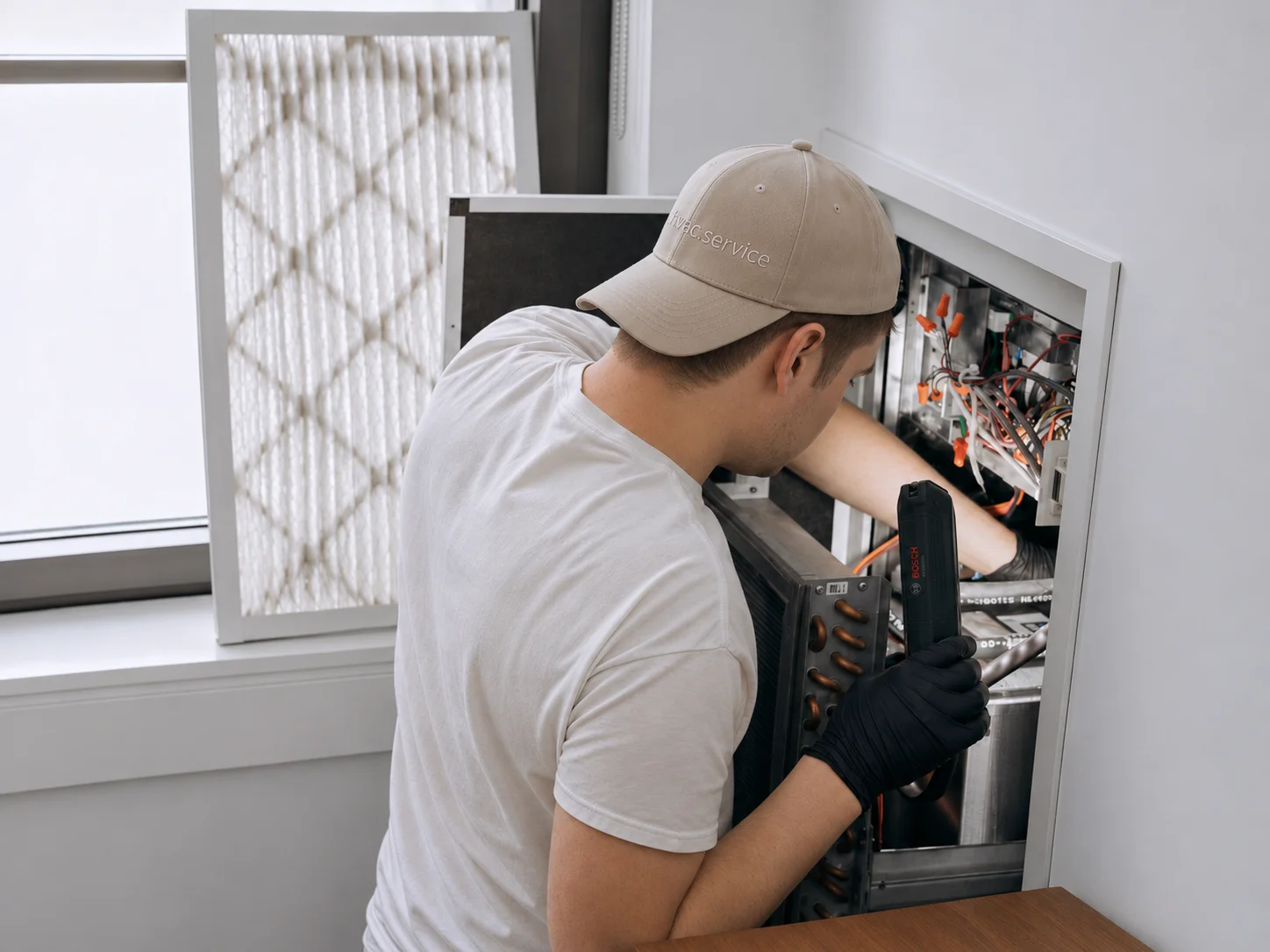
ONE SYMPTOM CAN HAVE SEVERAL CAUSES
Air conditioning problems are often less obvious than they seem. Warm air can be connected to low refrigerant, compressor trouble, condenser fan failure, or a dirty condenser coil. Weak airflow may come from a filter, blower, frozen evaporator coil, or another restriction inside the system. Similar symptoms can also appear when electrical components or controls begin to fail intermittently, which makes diagnosis by symptom alone unreliable.
HVAC.Services checks how the system is actually operating before recommending a repair. Airflow, coil condition, refrigerant performance, electrical components, controls, and temperature response can all be tested to narrow the problem down to its real source. The technician also looks at how the different parts of the system are affecting one another, since a problem in one area can create symptoms somewhere else. This helps avoid unnecessary part replacement and keeps the repair focused on the actual fault.
AC SYSTEM DIAGNOSTICS
TESTING THE CONDITIONS BEHIND THE FAILURE
AIRFLOW AND TEMPERATURE TESTING
We check supply and return airflow, temperature difference, filter condition, blower performance, and coil airflow to see whether the system is moving enough conditioned air through the space.
REFRIGERATION AND HEAT TRANSFER
Refrigerant pressures, coil temperatures, compressor operation, condenser performance, and heat-transfer conditions are evaluated when cooling capacity is low or the system is freezing.
ELECTRICAL AND CONTROL TESTING
Electrical connections, capacitors, relays, sensors, thermostat signals, and control response are checked when the AC will not start, cycles incorrectly, or operates unpredictably.
COMMON AIR CONDITIONER REPAIRS
CAPACITORS
& CONTACTORS
Failed capacitors and worn contactors can prevent the compressor or fan motor from starting correctly, cause intermittent operation, or lead to repeated shutdowns.
FAN & BLOWER
MOTORS
Motor problems can reduce airflow, stop heat from leaving the system properly, create unusual noise, or cause the AC to run without delivering normal cooling.
THERMOSTATS
& SENSORS
Faulty thermostats, temperature sensors, or control signals can cause incorrect cycling, inconsistent temperatures, delayed startup, or poor response to settings.
REFRIGERANT
LEAKS
Low refrigerant usually indicates a leak rather than normal consumption. The source should be identified before the system is recharged so the cooling problem does not quickly return.
EVAPORATOR
& CONDENSER COILS
Coil damage, corrosion, dirt buildup, or restrictions can interfere with heat transfer and lead to weak cooling, icing, higher operating temperatures, or reduced system capacity.
DRAINAGE
& CONDENSATE
Blocked drains, damaged pans, or condensate problems can cause water leakage around the unit and may also trigger safety switches that shut the AC down.
FAQ
Warm air can result from several different problems, including low refrigerant, compressor trouble, a condenser fan failure, dirty condenser coils, frozen evaporator coils, or a control issue. The symptom alone does not show which component has failed, and different faults can produce almost identical temperature problems at the vents.
HVAC.Services diagnoses the system under operating conditions so the cause of the temperature problem can be isolated instead of replacing parts based only on the symptom. Temperature readings, airflow, coil condition, and refrigeration performance help narrow the fault down before repair begins.
Ice on an evaporator coil often develops when airflow across the coil is too low or the refrigeration system is not operating correctly. Dirty filters, restricted coils, blower problems, or low refrigerant can all contribute to freezing. Once ice builds up, airflow can fall even further and cooling performance may drop quickly.
HVAC.Services checks both airflow and refrigeration conditions because simply allowing the ice to melt does not correct the problem that caused the coil to freeze. The source of the restriction or refrigeration issue needs to be identified before normal operation can be restored.
Water around an AC system may be caused by a blocked condensate drain, damaged drain pan, frozen evaporator coil, drainage problem, or excessive moisture collecting where it should not. Some systems may also shut down when a condensate safety switch detects rising water. A leak can therefore be related either to drainage itself or to another operating problem inside the system.
HVAC.Services inspects the drainage system together with coil and airflow conditions to determine whether the leak is a drainage problem or a symptom of another AC failure. This helps avoid clearing a drain while missing the condition that caused the excess water in the first place.
An AC that does not start may have a failed capacitor, contactor, thermostat, control component, safety switch, electrical connection, or another problem preventing the compressor or fan from operating. The cause may be relatively simple or may involve a fault elsewhere in the startup sequence.
HVAC.Services checks the electrical and control sequence to locate where startup is being interrupted before parts are replaced. This includes confirming that the system is receiving the correct signals and identifying which component is preventing normal operation.
In many cases, yes, but the location and condition of the leaking component determine whether repair is practical. Refrigerant is contained in a sealed circuit, so a system that has lost refrigerant usually has a leak that should be located rather than repeatedly recharged without addressing the source. Leaks can develop at fittings, tubing, coils, or other points in the refrigeration circuit.
HVAC.Services evaluates refrigeration performance and the condition of the system before recommending leak repair, component replacement, or another appropriate solution. The repair approach depends on where the leak is found and whether the affected part can be repaired economically.
Experience the HVAC.SERVICES Difference


