

Double-Door Refrigerator & Freezer
COMMERCIAL REFRIGERATION SERVICE
STABLE TEMPERATURES FOR COMMERCIAL COLD STORAGE
Commercial double-door refrigerators and freezers operate continuously in restaurants, cafés, bars, and other food-service environments where frequent door openings, heavy product loads, and warm kitchen conditions place constant demand on the refrigeration system. A change in temperature, airflow, or compressor operation can quickly affect one or both sections of the cabinet.
HVAC.Services provides diagnostics and repair for commercial double-door refrigerators and freezers, including cooling problems, compressor issues, fan and coil faults, control problems, door seal failures, defrost issues, and sealed-system conditions.
COMMON DOUBLE-DOOR REFRIGERATION PROBLEMS
NOT HOLDING TEMPERATURE
The cabinet runs warmer than expected, cools too slowly, or one section cannot maintain the set temperature during normal kitchen use.
COMPRESSOR & COOLING ISSUES
The compressor may fail to start, cycle repeatedly, run continuously, or operate without producing enough cooling for the refrigerator or freezer section.
FROST & AIRFLOW PROBLEMS
Ice buildup, weak airflow, or uneven temperatures can develop when evaporator fans, coils, defrost components, or airflow paths are not working correctly.
DOOR & CONTROL FAILURES
Worn gaskets, misaligned doors, faulty sensors, or control problems can allow warm air into the cabinet or disrupt normal cooling and temperature cycles.
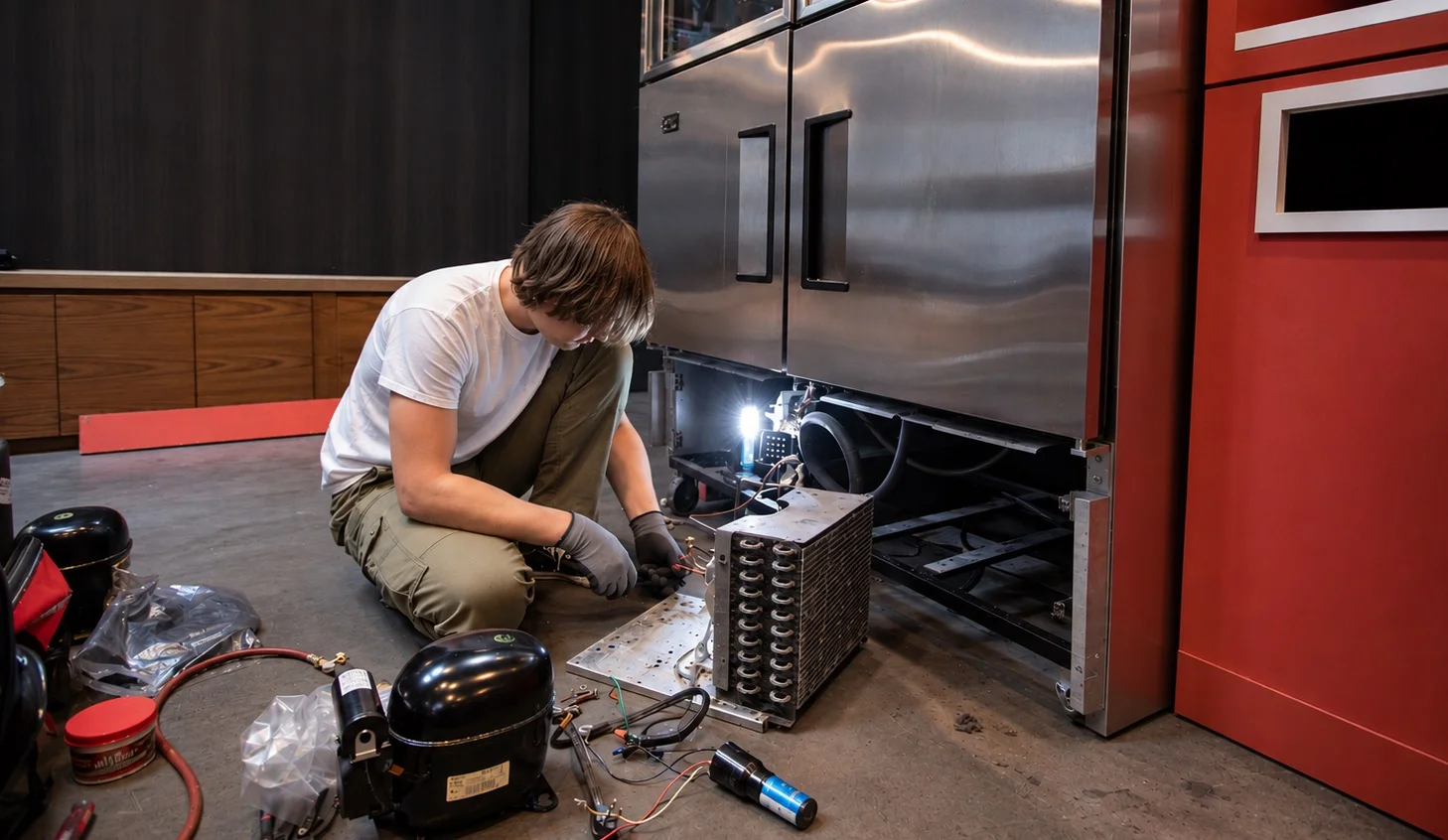
ONE TEMPERATURE PROBLEM CAN HAVE SEVERAL CAUSES
A commercial double-door refrigerator or freezer depends on several systems working together to maintain stable temperatures across both cabinet sections. The compressor, condenser, evaporator, fans, refrigerant circuit, sensors, controls, and door seals all influence how efficiently heat is removed and cold air is distributed.
Warm temperatures, long run times, frost buildup, or uneven cooling do not automatically point to a single failed component. Restricted airflow, dirty coils, fan problems, defrost faults, door leaks, control issues, or sealed-system conditions can create similar symptoms. HVAC.Services tests the refrigeration system before recommending parts or major repair work.
COMMERCIAL REFRIGERATOR & FREEZER DIAGNOSTICS
HOW WE CHECK THE REFRIGERATION SYSTEM
TEMPERATURE & AIRFLOW TESTING
Cabinet temperatures, airflow, evaporator fan operation, condenser airflow, and visible icing are checked to determine how effectively cold air is being produced and distributed through both sections.
REFRIGERATION SYSTEM TESTING
Compressor operation, start components, refrigerant conditions, condenser performance, and evaporator performance are evaluated when the unit cools slowly, runs continuously, or cannot maintain the set temperature.
CONTROLS & CABINET CONDITION
Temperature sensors, electronic controls, defrost components, door gaskets, hinges, and door alignment are checked for conditions that can affect cooling cycles, frost formation, and temperature stability.
REFRIGERATOR & FREEZER COMPONENTS WE SERVICE
COMPRESSOR
& START COMPONENTS
The compressor, relay, overload, capacitor, and related electrical parts are checked when the refrigeration system will not start, cycles repeatedly, or runs without producing enough cooling.
CONDENSER COIL
& FAN
The condenser removes heat from the refrigeration system. Dirt buildup, restricted airflow, or a failed fan can increase operating pressure and reduce cooling performance.
EVAPORATOR COIL
& FAN
The evaporator absorbs heat inside the cabinet, while the fan distributes cold air through the refrigerator or freezer. Icing, fan failure, or restricted airflow can create uneven temperatures.
DEFROST
SYSTEM
Defrost heaters, sensors, timers, and controls help prevent excessive ice from building up around the evaporator and restricting airflow through the cabinet.
TEMPERATURE CONTROLS
& SENSORS
Thermostats, sensors, and electronic controllers determine when cooling starts and stops. Incorrect readings or control faults can cause unstable temperatures or unusual cycling.
DOORS, GASKETS
& DRAINAGE
Door gaskets, hinges, alignment, drain pans, and condensate paths affect how much warm air and moisture enter or remain inside the refrigerator or freezer cabinet.
FAQ
Temperature problems can result from dirty condenser coils, restricted evaporator airflow, failed fans, worn door gaskets, control or sensor faults, refrigerant conditions, or compressor problems. Frequent door openings and heavy kitchen use can make an existing refrigeration problem more noticeable because the system has to recover temperature repeatedly.
HVAC.Services checks cabinet temperature, airflow, coils, fans, controls, doors, and refrigeration performance to determine why the unit is no longer maintaining stable cooling.
Uneven temperatures can develop when cold air is not circulating correctly through the cabinet. A fan problem, blocked airflow path, evaporator icing, product placement, sensor issue, or poor door seal may affect one area more than another even though both sections share the same refrigeration system.
HVAC.Services compares temperature and airflow across the cabinet and checks the components responsible for distributing cold air before determining what needs to be repaired.
Heavy frost can be caused by a defrost-system fault, restricted airflow, an evaporator fan problem, damaged door gaskets, poor door alignment, or warm moist air repeatedly entering the cabinet. Ice around the evaporator can eventually restrict airflow enough to reduce cooling performance throughout the freezer.
HVAC.Services checks the evaporator area, defrost components, fans, sensors, doors, and sealing conditions to identify why abnormal frost is forming.
A compressor may run for unusually long periods when the refrigerator cannot remove heat efficiently or when the cabinet continues gaining heat faster than expected. Dirty condenser coils, failed fans, door leaks, incorrect temperature readings, heavy frost, or refrigeration-system problems can all increase compressor run time.
HVAC.Services evaluates compressor operation together with airflow, heat transfer, controls, and cabinet conditions rather than assuming that continuous operation means the compressor itself has failed.
Repair cost depends on the cause of the failure, the components involved, accessibility, required labor, and whether replacement parts are needed. A temperature problem caused by a fan, sensor, gasket, or control can involve very different work from a compressor or sealed-system repair, even though the initial symptom may look similar.
HVAC.Services performs professional diagnostics first and provides a clear repair estimate after the cause has been identified, so the customer can decide how to proceed before additional work is completed.
Experience the HVAC.SERVICES Difference


