

HVAC Maintenance
ROUTINE CARE FOR HOME COMFORT
RESIDENTIAL HVAC PREVENTIVE SERVICE
HVAC equipment works through both heating and cooling seasons, often for months without being checked. Routine maintenance gives a technician the opportunity to inspect the system, check its operation and airflow, replace filters as needed, and make sure the equipment is ready for the season ahead.
PROFESSIONAL HVAC MAINTENANCE
VS DIY CHECKS
TASK
DIY CHECKS
PROFESSIONAL
MAINTENANCE
MAINTENANCE
Replace / Inspect Air Filter
✓
✓
Keep Vents Clear
✓
✓
Watch for Noise or Odors
✓
✓
Remove Visible Debris
✓
✓
Check Thermostat Operation
✓
✓
Inspect Electrical Components
−
✓
Measure Airflow & Performance
−
✓
Inspect Coils & Drainage
−
✓
Check Refrigerant Conditions
−
✓
Full Operating Inspection
−
✓
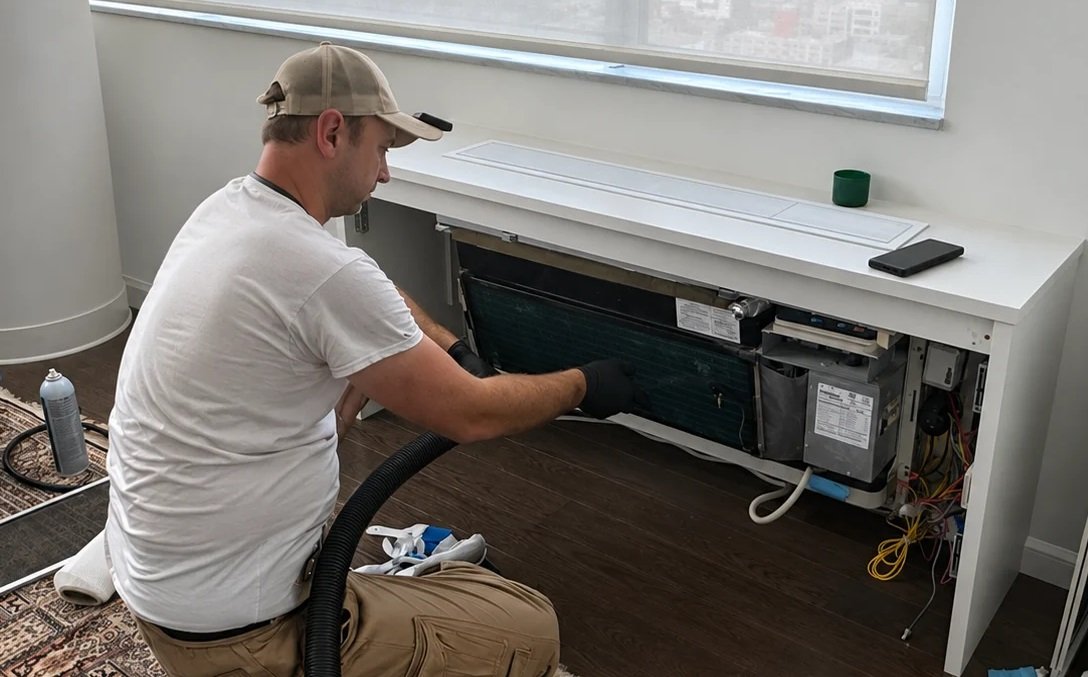
A PROFESSIONAL LOOK AT SYSTEM CONDITION
Residential HVAC systems can be installed in very different ways, especially in New York homes and apartments where equipment is often compact, built into tight spaces, or connected to older ductwork and controls. A maintenance visit gives the technician time to inspect how the system is actually operating, check airflow, filters, coils, drainage, controls, and other accessible components, and note anything that may need attention.
HVAC.Services technicians use professional diagnostic tools and work with a wide range of residential heating and cooling equipment. The goal is to give the homeowner a clear picture of the system’s condition and recommend only the service that makes practical sense.
HOW RESIDENTIAL HVAC MAINTENANCE WORKS
01
EQUIPMENT REVIEW
We review accessible HVAC components, filters, coils, drainage, wiring, and visible buildup to assess the equipment’s physical condition.
02
INSTRUMENT TESTING
Professional instruments are used to measure operating pressures, temperatures, airflow, and other system-specific performance parameters.
03
PREVENTIVE SERVICE
Filters are replaced as needed, routine maintenance items are addressed, and deeper cleaning needs are identified for separate service.
04
SYSTEM VERIFICATION
The system is restarted and checked through a normal operating cycle to confirm airflow, controls, drainage, and overall system response.
Experience the HVAC.SERVICES Difference


FAQ
For most residential HVAC systems, regular service before the main heating and cooling seasons provides a practical maintenance schedule. The actual frequency depends on the type and age of the equipment, operating hours, indoor conditions, filter condition, and how heavily the system is used throughout the year. Equipment that runs almost continuously during extreme weather or has not been professionally checked for several years may require closer attention.
HVAC.Services can evaluate the equipment during a maintenance visit and recommend a service schedule based on its actual condition rather than applying the same interval to every home. Seasonal service also provides an opportunity to identify maintenance needs before the equipment enters its busiest period.
Professional HVAC maintenance typically includes a review of accessible equipment, filters, coils, drainage, electrical components, controls, airflow, and general operating condition. The technician also looks for dirt buildup, signs of wear, loose or deteriorated connections, and conditions that may interfere with normal heating or cooling. Depending on the type of system, professional instruments may be used to measure pressures, temperatures, airflow, and other operating parameters.
HVAC.Services technicians combine equipment review with instrument-based testing rather than relying only on what can be seen from the outside. This provides the homeowner with a clearer picture of how the system is actually operating and what, if anything, deserves further attention.
Regular maintenance can reveal restricted airflow, dirty components, drainage problems, abnormal operating conditions, deteriorating electrical parts, and signs of wear before they develop into larger service issues. A clogged filter or restricted coil, for example, can place additional strain on motors and other components even though the system may continue to run. Maintenance also gives the technician an opportunity to compare normal operating conditions with anything that appears unusual.
HVAC.Services technicians focus on identifying conditions that deserve attention while there is still time to plan the appropriate service. The objective is not to manufacture repair work, but to give homeowners useful information about the condition of their equipment before a developing issue becomes an emergency.
Homeowners can handle several useful tasks between professional service visits, including checking or replacing filters, keeping supply and return vents clear, removing visible debris around accessible equipment, and paying attention to changes in airflow, noise, odors, or temperature. These basic steps can support normal system operation, but they do not provide information about internal components, refrigerant conditions, electrical performance, or measured system operation.
HVAC.Services technicians use professional diagnostic equipment to evaluate pressures, temperatures, electrical conditions, airflow, and other parameters appropriate to the specific HVAC system. Professional maintenance complements homeowner care by checking areas and operating conditions that cannot be reliably evaluated without HVAC tools and technical training.
About every 90 days is a common starting point, but filter life varies considerably from one home to another. Filter type, system runtime, pets, occupancy, renovation dust, indoor air conditions, and filtration efficiency can all affect how quickly a filter loads with particles. Higher-efficiency filters may capture finer contaminants but can also become restrictive sooner. A dirty filter reduces airflow and forces the blower to work harder to move air through the system.
During HVAC maintenance, our technicians can inspect filter condition together with airflow and equipment operation rather than judging the filter in isolation. HVAC.Services can then recommend a replacement interval that makes sense for the specific home and the way its HVAC equipment is being used.